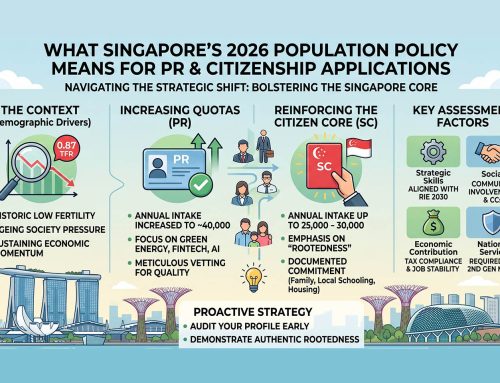

Individuals opting to apply for permanent residency in Singapore should be informed about the current process. The Singapore PR application online processes in 2026 have been updated to reflect stricter evaluation standards, improved digital systems, and refined eligibility criteria. Applicants using the online application for Singapore PR must now meet updated requirements related to documentation, employment stability, and contribution assessment. These changes aim to improve transparency, streamline processing, and ensure that applications align with Singapore’s long-term economic and social goals.
What the 2026 PR Policy Updates Mean
The 2026 updates refer to adjustments made to the evaluation and submission process for PR application in Singapore. These changes affect how applications are assessed rather than introducing an entirely new system.
The updates focus on three main areas: eligibility refinement, documentation requirements, and processing transparency. Applicants are now expected to provide clearer evidence of their contributions and integration into Singapore society.
The goal of these changes is to prioritise applicants who demonstrate long-term commitment, economic value, and social integration.
Updated Eligibility Criteria
Eligibility criteria define who can apply for PR and how their profiles are assessed. In 2026, the criteria have become more structured and data-driven.
Applicants are now assessed based on a combination of employment, education, and integration factors. Authorities are placing more emphasis on long-term contribution rather than short-term employment status.
The key eligibility considerations now include:
- Stability of employment and income over time
- Educational background aligned with industry needs
- Length of stay and residency history in Singapore
- Family ties and integration into local society
These criteria apply across different schemes, including professionals, spouses, and family-based applications.
Changes in the Online Application Process
The online application for Singapore PR remains the primary submission method, but the system has been enhanced for accuracy and verification.
The updated process introduces stricter validation checks and improved data integration with government systems. This reduces errors and ensures that submitted information matches official records.
Applicants completing a Singapore PR application online should expect:
- More detailed digital forms with structured fields
- Mandatory document uploads in standardised formats
- Automated verification of employment and identity data
- Reduced reliance on manual follow-ups
These improvements aim to streamline submissions while maintaining strict compliance standards.
Revised Documentation Requirements
Documentation requirements refer to the supporting evidence needed to validate an application. Currently, the requirements have become more comprehensive and specific.
Applicants must now provide clearer and more consistent records that reflect their employment, financial stability, and personal background. Incomplete or inconsistent documents may lead to delays or rejection.
The most commonly required documents include:
- Employment letters and salary records
- Educational certificates and transcripts
- Tax records or income statements
- Identification and family documents
Additional documentation may be requested depending on the applicant’s profile, especially for self-employed individuals or business owners.
Enhanced Evaluation Criteria by Authorities
Evaluation criteria determine how each application is reviewed. In 2026, authorities have adopted a more holistic and data-supported approach.
Applications are no longer assessed based on single factors. Instead, multiple aspects of the applicant’s profile are considered together to form a comprehensive evaluation.
The evaluation now focuses on:
- Economic contribution to Singapore’s workforce
- Long-term employability and industry relevance
- Social integration and community participation
- Family stability and local ties
This approach ensures that PR approvals align with national priorities and long-term planning.
Processing Time and Application Transparency
Processing time refers to how long it takes for an application to be reviewed and a decision issued. Improvements have been made to increase transparency in this area.
Applicants submitting a Singapore PR application online may experience more predictable timelines due to system upgrades. However, processing duration still depends on the complexity of the application.
Applicants can expect:
- More consistent processing timelines
- Clearer status updates through the online portal
- Reduced delays caused by missing documents
Despite these improvements, applications requiring additional verification may still take longer.
Common Reasons for Application Rejection
Rejection reasons highlight areas where applications do not meet the required standards. At present, these reasons are more closely tied to data accuracy and profile consistency.
Applicants are expected to provide complete and verifiable information. Any inconsistencies may impact the outcome of the application.
Common reasons for rejection include:
- Incomplete or inconsistent documentation
- Insufficient employment stability
- Weak alignment with Singapore’s economic needs
- Limited evidence of social integration
Understanding these factors helps applicants prepare stronger submissions.
How Applicants Should Adapt to the New Rules
Adapting to the new rules involves aligning application strategies with updated expectations. Applicants should focus on accuracy, consistency, and long-term positioning.
Preparation is now more important than ever, as the evaluation process relies heavily on verified data and structured information.
Applicants should consider the following steps:
- Review eligibility criteria carefully before applying
- Prepare complete and consistent documentation
- Ensure employment and income records are up to date
- Provide clear evidence of integration and local ties
These steps help improve the overall quality of the application.
Differences Between Previous and 2026 PR Application Rules
| Aspect | Before 2026 | 2026 Updates |
| Eligibility Focus | General assessment | Data-driven and structured evaluation |
| Documentation | Basic requirements | More detailed and standardised |
| Application Process | Manual checks involved | Automated verification systems |
| Evaluation Criteria | Individual factors | Holistic multi-factor assessment |
| Transparency | Limited updates | Improved tracking and status clarity |
This comparison highlights how the system has evolved to prioritise accuracy and consistency.
Role of Digital Systems in PR Applications
Digital systems now play a central role in managing PR applications. The 2026 updates have strengthened integration between application portals and government databases.
This allows authorities to verify information more efficiently and reduce reliance on manual checks. It also improves the accuracy of application reviews.
Applicants should ensure that all submitted information matches official records, as discrepancies can be easily detected through these systems.
Impact on Different Applicant Categories
Different applicant categories may experience the updates differently depending on their profiles.
Professionals and skilled workers are evaluated more closely based on industry relevance and employment stability. Family-based applicants are assessed based on relationship authenticity and integration.
The impact varies depending on the type of application, but the overall approach remains consistent: a focus on long-term contribution and integration.
Frequently Ask Questions (FAQs)
Key Takeaways from the 2026 PR Updates
The 2026 updates to PR applications in Singapore reflect a more structured and data-driven approach to immigration. Eligibility, documentation, and evaluation processes have all been refined to prioritise long-term contribution and integration.
Applicants using the Singapore PR application online system must ensure accuracy, consistency, and completeness in their submissions. Understanding these changes is essential for preparing a well-structured application.
For individuals seeking guidance on preparing documents, understanding eligibility, or navigating the updated Singapore PR application online process, it may be useful to consult a trusted immigration specialist today for structured support.