Singapore has made a clear move to adjust how it manages its population over the next few years. The latest announcement outlines a steady intake of new citizens and permanent residents to support long-term growth. This shift matters for anyone looking at Singapore PR and citizenship 2026 as part of their plans. The policy is not just about numbers. It reflects how the country plans to stay stable while dealing with an ageing population and fewer births.
Many applicants focus only on approval rates. That approach misses the bigger picture. The new policy explains what the government values in applicants and how decisions may be shaped in the coming years. It also highlights the type of profiles that may stand out more in this environment.
A Clear Shift in Population Strategy
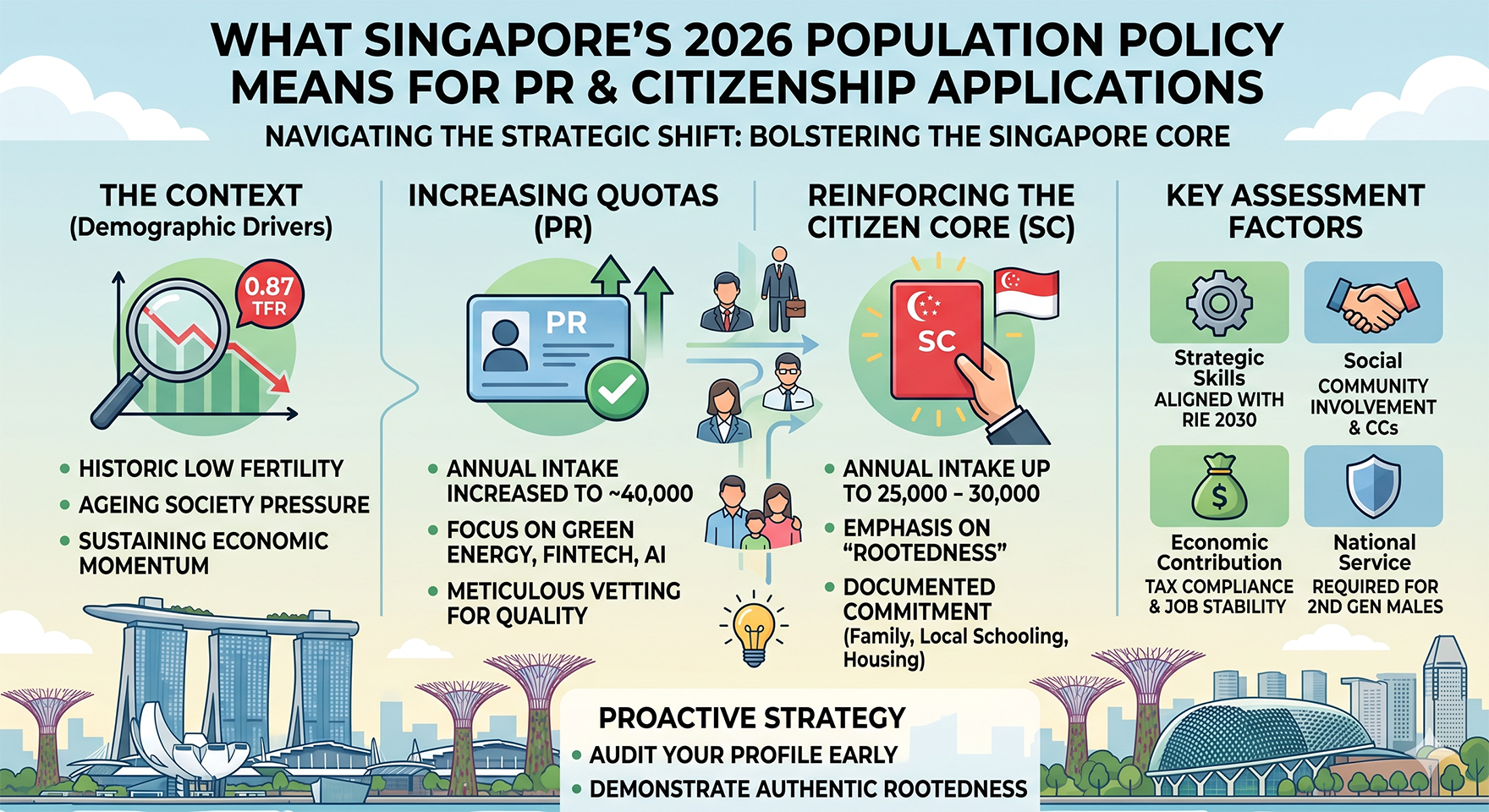
Singapore plans to take in between 25,000 and 30,000 new citizens each year over the next five years. Permanent resident intake is expected to reach about 40,000 annually. These numbers are higher than in previous years, which signals a stronger demand for new residents.
This change is tied to a long-term issue. The country’s birth rate has dropped to one of the lowest levels on record. A smaller, younger population creates pressure on the workforce and the economy. More working adults are needed to keep systems running smoothly.
Growth is not the only goal here. Stability also plays a big role. The government has stated that immigration will be managed at a pace that matches infrastructure and social balance. That means intake may increase, but it will still be controlled.
Why Singapore Needs More People Now
A falling birth rate changes how a country functions over time. Fewer young people means fewer workers in the future. At the same time, the number of older residents continues to rise. This creates a gap that needs to be filled.
Singapore is dealing with several pressures at once. A shrinking workforce can slow economic growth. Healthcare demand rises as the population ages. Public systems need more support to keep up with these changes.
Immigration becomes part of the solution. New residents add to the workforce and support economic activity. They also help balance the population structure. This approach allows Singapore to maintain its position as a strong business and financial hub.
There is also a financial angle. Working-age immigrants contribute through taxes and savings schemes. They begin contributing right away, unlike a newborn who requires years of support before entering the workforce. This makes immigration a practical move from a planning perspective.
Higher Intake Does Not Mean Easier Approval
More available slots may sound like good news. It suggests more opportunities for applicants. At the same time, the selection process remains strict. The government has made it clear that standards are not being lowered. Each application is still reviewed based on multiple factors. These include work history, time spent in Singapore, and level of integration into society.
Competition is still strong. A larger intake often brings more applicants into the system. This keeps the selection process competitive. Strong profiles will continue to stand out, while weaker ones may struggle. This means planning matters more than ever. Applicants need to look beyond timing and focus on building a strong overall profile.
Permanent Residency as the First Step
Permanent residency remains the main path toward citizenship. The process usually begins with securing PR status and building a track record over time. PR applications tend to focus on economic contribution. Stable employment and steady income play a big role here. Employers also become part of the picture through ongoing work relationships.
Time spent in Singapore is another factor. Short stays may not carry the same weight as longer ones. A few years of consistent work and living experience can strengthen an application. Once PR is granted, the next stage begins. Citizenship applications often look at deeper ties. This includes family connections, community involvement, and long-term commitment to staying in the country.
What “Selective” Really Means for Applicants
The term “selective” comes up often in policy discussions. It may sound vague, but it points to several clear ideas. First, family ties matter. Applicants with connections to Singapore citizens or residents often show stronger commitment. These ties suggest a long-term plan to stay.
Second, education in Singapore can strengthen a profile. Those who studied locally tend to adapt more easily to social norms. They also build networks that last beyond school. Third, work experience in Singapore carries weight. Long-term employment shows stability and contribution. It also reflects how well an applicant fits into the local workforce.
Lastly, time matters. Living in Singapore for several years shows a level of commitment that short stays cannot match. The longer the connection, the stronger the signal.
The Role of Job Stability in Your Profile
Employment patterns are closely observed in applications. Stability often carries more weight than short-term income gains. A steady job over several years shows consistency. It suggests that the applicant is reliable and settled. Employers also play a part in this signal through continued support and renewal of work passes.
Frequent job changes can raise concerns. It may suggest uncertainty or a lack of long-term plans. Each job switch resets part of the employment track record. Career progression still matters. Moving into higher roles within the same company can strengthen a profile. It shows growth without losing stability.
Applicants should think carefully about timing. A job change close to an application may affect how the profile is viewed. Staying in a stable role during the application period often works better.
How Ethnic Balance Shapes Immigration Decisions
Singapore maintains a balance across different ethnic groups within its population. This approach is part of its long-term social planning. The government monitors this balance closely. Changes are made carefully to avoid major shifts. This means immigration intake is adjusted to match existing proportions. Applicants are assessed as individuals, but this broader framework still exists in the background. It can affect competition levels across different groups.
Some groups may face higher competition due to a larger number of applicants. Others may have slightly different dynamics based on demand and available slots. This factor is rarely discussed openly, but it plays a role in shaping outcomes. Applicants should be aware that broader population planning may influence results.
Integration is Becoming More Important
Integration has become a stronger focus in recent years. It goes beyond living and working in Singapore. Community involvement is one example. Taking part in local activities shows a connection to society. It reflects a willingness to be part of the community. Social ties also matter. Building relationships with locals can strengthen an application. It shows that the applicant is not isolated.
Programs have been introduced to support integration. These include initiatives that help new residents adapt to local culture and norms. This trend is likely to continue. Integration is becoming a key part of how applicants are assessed. Passive presence is no longer enough.
PR vs Citizenship: What Changes at Each Stage
Permanent residency and citizenship follow a connected path, but they are not the same. Each stage looks at different signals. PR focuses more on economic contribution and stability. Citizenship shifts attention to long-term commitment and social ties.
Applicants often move too quickly from PR to citizenship. Time as a PR helps build a stronger case. It allows you to show consistency in work, daily life, and community involvement. A short gap between PR approval and citizenship application may weaken the narrative.
Citizenship also carries a deeper expectation. It reflects a long-term decision to stay in Singapore. That idea needs to be visible in your lifestyle, not just your documents. A strong application tells a clear story about why Singapore is your permanent home.
Timing Your Application in the 2026–2030 Window
The next few years present a unique opportunity. Intake targets are higher than past averages. This creates a wider window for applicants who are ready.
Timing still matters. A rushed application can lead to rejection. A strong profile submitted at the right moment has a better chance. It is not about applying early. It is about applying when your profile is complete.
This period may not last forever. A review is expected around 2030. Policies may shift again depending on population trends and public sentiment. That makes this window important for long-term planning.
Applicants should use this time to strengthen weak areas. Focus on stability, integration, and consistency. When those elements are in place, timing becomes an advantage.
Why Families May Have a Stronger Position
Families often show deeper roots in Singapore. This comes from shared commitments and long-term plans. Children in local schools add another layer to that connection.
A child’s education path reflects long-term intent. Local schooling ties a family to the system and community. It shows that the family plans to stay and grow within Singapore.
Marriage also plays a role. A spouse who is a citizen or PR adds stability to the profile. It signals a stronger connection to the country beyond work.
Single applicants can still succeed. They may need to show a stronger economic contribution and a longer time in Singapore. Their profile needs to reflect stability in other ways.
Common Mistakes That Can Affect Applications
Some patterns appear often in weaker applications. Short stays are one of them. A limited time in Singapore may not show enough commitment.
Frequent job changes can also create concern. It may suggest uncertainty or a short-term mindset. Stability in work helps build trust in the application.
Lack of community involvement is another gap. Living in Singapore without engaging with the local environment weakens the profile. Integration is now a key part of assessment.
Applying at the wrong time can also affect results. Submitting during a job transition or unstable period may reduce the strength of the case. Planning helps avoid this issue.
Building a Stronger Application Profile
A strong profile is built over time. It combines several elements that work together. Work history, community ties, and personal connections all play a role.
Consistency is one of the most important factors. Staying in a stable role and building a steady career path helps. It shows reliability and long-term commitment.
Integration should also be visible. This can include community activities or local involvement. Small actions over time create a stronger overall picture.
Clear intent matters as well. Your application should reflect a genuine plan to stay in Singapore. That message should come through in both your background and your future plans.
How Majestic Immigration Singapore Supports Your Journey
At Majestic Immigration Singapore, we take a direct and structured approach to your application. We look at your profile as a whole and identify areas that need improvement. This helps you move forward with a clearer strategy.
We guide you through each stage of the process. From PR planning to citizenship preparation, we focus on timing, positioning, and presentation. Each step is aligned with current policy signals and real application trends.
At Majestic Immigration Singapore, we also help shape your application narrative. This includes how your work history, lifestyle, and long-term plans are presented. A well-structured case can make a meaningful difference.
Our goal is to help you move with purpose. A strong application is not built overnight. With the right direction, your profile can reflect the qualities that Singapore looks for in new residents.
Moving Forward with a Clear Plan
Singapore’s 2026 population policy shows a clear direction. The country needs new residents, but it remains selective in its approach. Strong applications will reflect stability, integration, and long-term intent.
This is a window of opportunity for those who are prepared. Building a strong profile takes time, but the effort can lead to better outcomes. Each decision you make now can shape your future application.
Work, community, and personal ties all contribute to the bigger picture. When these elements align, your application becomes stronger and more convincing.
Start your journey with us today and take the next step toward PR or citizenship with a clear and focused strategy.